 CatchyName
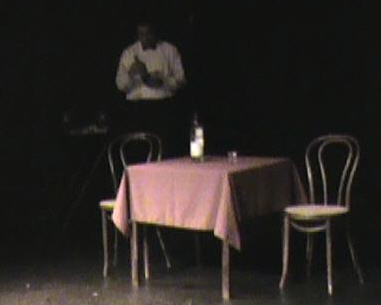
performed the one-act version Mitch for the San Francisco Fringe Festival
2008 at the Phoenix Theatre featuring Joy Breed, Vonn Scott Bair, Abhi Katyal,
Jesse Mueller, Kirsten Solveig and Irving Schulman.
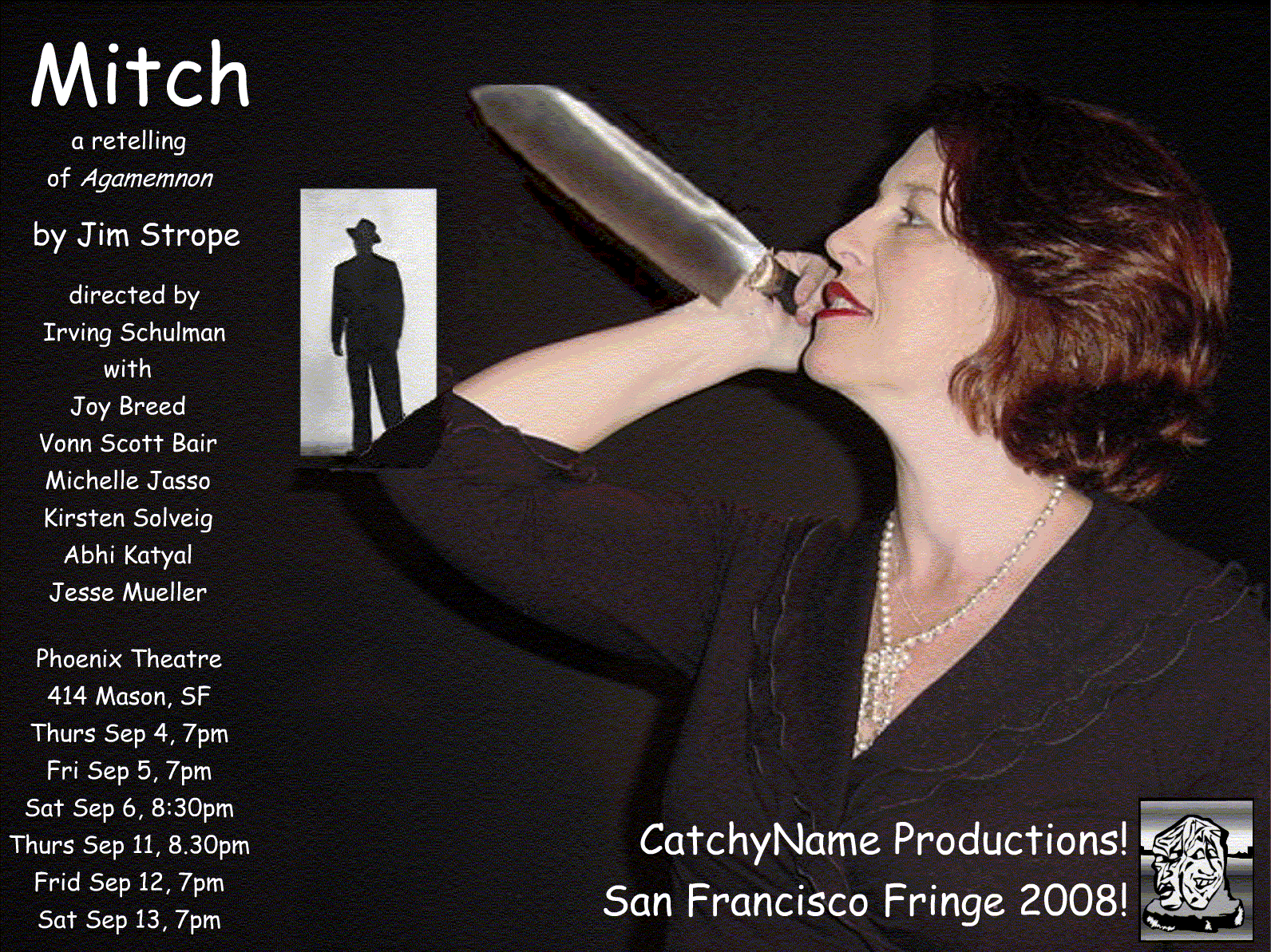
CatchyName
performed the one-act version Mitch for the San Francisco Fringe Festival
2008 at the Phoenix Theatre featuring Joy Breed, Vonn Scott Bair, Abhi Katyal,
Jesse Mueller, Kirsten Solveig and Irving Schulman. The
Writing of Mitch Mikinos
The play started as depiction of a mother visiting her unreachable daughter in a mental hospital. The daughter sensed that she had control of the situation and used her power to torment her mother.
I realized that the daughter could be Iphigenia, the
daughter that Agamemnon sacrificed for a favorable wind to take the Greek fleet
to
The Light in November was an early version of the
play read at Playwright’s Center when the workshop met at the Blue Bear
Theatre at
CatchyName
performed the one-act version Mitch for the San Francisco Fringe Festival
2008 at the Phoenix Theatre featuring Joy Breed, Vonn Scott Bair, Abhi Katyal,
Jesse Mueller, Kirsten Solveig and Irving Schulman.
To unify the background of the character of Agamemnon, I chose to assemble from various sources all the worst gossip I could find about him and his family. This condensed story is as follows.
Tantalus invited the gods to dinner and served them a stew that featured the body of his own son, Pelops (Dark Eyed), for which the gods punished him according to the well-known legend and thus began the curse of murder and cannibalism on the family.
Pelops was reassembled by the gods and married Hippodamia, having three sons Atreus, Thyestes, and Chrysippus.
Thyestes and Atreus murdered their brother Chrysippus.
As a guest in the
Years later, when Thyestes begged forgiveness, Atreus ordered his sons Agamemnon and Menelaus to murder, butcher, and cook the two sons of Thyestes (Pleisthenes and Tantalus) and serve them to the unknowing father. Because the sons could not have a proper burial, Atreus had created a vengeance on Thyestes that would be eternal.
Thyestes left the palace for a second time, determine to avenge himself on the house of Atreus.
On the advice of an oracle, Thyestes fathered a son, Aegisthus, by his own daughter, Pelopia. Aegisthus was brought up by the unknowing Atreus and, when the young man matured, Atreus directed Aegisthus to kill Thyestes, his own father.
However the knife that Aegisthus was to use for the murder was the very knife that Pelopia had obtained from Thyestes, who recognized it in the hands of Aegisthus. Thus father and son were reunited, the story was revealed, and Aegisthus vowed revenge on Atreus.
Aegisthus killed Atreus and Agamemnon assumed the throne of
When Helen eloped with
Odysseus lured Iphigenia, Agamemnon’s first born, to
However, they sacked the city of Chryses on the way, and captured the princess daughter. A curse was laid upon the Greek fleet that was lifted only when Agamemnon returned the princess. Agamemnon then demanded of Achilles his favorite slave girl, an act that poisoned the relationship between Agamemnon and Achilles, driving Achilles sulking to his tent for most of the war.
During the war, Agamemnon killed at least 8 Trojan warriors in battle, including 3 sets of brothers.
While Agamemnon was in
When Agamemnon returned from the war with the Trojan
princess Cassandra his slave, Clytemnestra and Aegisthus killed the old warrior
for all of his crimes. Thus
Aegisthus avenged the unspeakable fate of his brothers, having the taken the
wife, life and
Electra and Orestes, the surviving children of Agamemnon, were compelled to avenge their father’s murder but were horrified that the revenge must fall upon their own mother. Orestes and Electra overcame their trepidations and eventually killed Aegisthus and Clytemnestra.
For the crime of matricide, the Furies haunted Orestes until he sought justice at the Areopagus, a court of elders near the Athenian Acropolis. There he was acquitted and the curse on his family was finally lifted.
|
Comparisons
between
the Old Story and Mitch |
||
|
Agamemnon |
Mitch |
Comment |
|
Foreboding prologue
given by a watchman |
Monologue given by
Ellen in which she details her claustrophobic life. |
|
|
Clytemnestra is the
central character in that she drives the action and kills her husband.
|
Ellen is the central
character in that she drives much of the action and kills her husband.
|
The central character
in both is the wife, a strong and willful individual who runs her own life
and kills her husband because of his crimes and because his death pleases
her ambitions. Helen was
Clytemnestra’s twin sister. |
|
Agamemnon (Illustrious
Spirit) |
Mitch Mikinos |
Mykinos is the modern
village outside of the ruins of ancient Mycenea. |
|
Clytemnestra (?
Sister) |
Ellen |
Helen was
Clytemnestra’s sister |
|
Orestes |
Russell |
Rusty |
|
Iphigenia
(Strong-Born) |
Jennifer |
Similar root? _gen_ |
|
Aegisthus (Goat-like) |
Brendan |
References related to
goats in modern American names? |
|
Cassandra (? Man) |
Cassandra |
Modern name |
|
Chorus of townspeople. |
Mr. Bane &
investors |
Off stage.
By reference only. |
|
|
Petey Levine |
Not on stage in most versions |
| Odysseus and Achilles | Hired thugs ("...those guys...") | Odysseus fabricated a wedding between Achilles and Iphigenia as a ruse to lure her to Aulis where she was sacrificed. In Mitch, they are hired to recover the money. |
|
Long speeches |
Short, Mamet-like
snatches of dialogue |
Prologue is a long
monologue. |
|
Agamemnon was king of |
Mitch is the owner of
the Atrium restaurant and a house in |
Atrium is a pun on
Atreus, father of Agamemnon |
|
Agamemnon was a great
warrior |
Mitch was an officer
in |
|
|
Agamemnon sacrifices
Iphigenia for a wind |
Mitch has Jennifer
killed for stealing from him |
|
|
Agamemnon’s victims: In the Iliad: Bienor,
Oilius, Isus, Antiphus, Pisander, Hippolochus, Iphidamas, Coön. First husband of
Clytemnestra: Tantalus. First son of
Clytemnestra: ? Two sons of Thyestes:
Pleisthenes, Tantalus. His daughter
Iphigenia. |
Unspecified number of
soldiers and civilians. His daughter Jennifer.
|
|
|
Incest theme:
Thyestes’ seduction of his sister-in-law started a cycle of revenge. Polopia,
the mother of Aegisthus, was also his sister.
|
Cousin Brendan seems
to be playing sexually with all the women in the play.
Rather than sexual incest, the play focuses financial incest.
|
A light tie-in.
|
|
Cannibalism theme:
Tantalus fed his son Pelops to the gods.
Agamemnon murdered his cousins and cooked them into a stew served
to Thyestes. |
How can I work this
in? Jennifer suggests that
Mitch can ‘…stew in his own juices…” and “… we eat our own
children…” Cassandra tries to leave, saying “… I don’t feel like
dinner…” |
A very light tie-in.
|
|
Aphoristic: Classical
Greek drama abounded in aphorisms. |
|
“…more full of
holes than a fishing net…” taken from the English translation.
“… in one ear and
out the other…” and others added.
|
|
Aegisthus’ revenge
was motivated by Agamemnon’s crimes against Aegisthus’ father.
|
Brendan felt swindled
out of his inheritance by Mitch. |
|
| Clytemnestra and Aegisthus kill Agamemnon and Cassandra with a knife or an axe. | Ellen kills Mitch and Cassandra with a knife. | |
I expanded the play, rewrote, staged more than one reading, began over, and rewrote as I achieved firmer footing in Greek drama and more stage experience. Mitch would be a drama in the classical Greek style but updated to postmodernity where dramatically convenient.
Clearly, some of the points of the Greek style are incompatible with modern life. His daughter could not be sacrificed for a wind in contemporary Pacific Heights, San Francisco. I invented a sub-plot, a crime in which Jennifer would threaten her father’s hegemony.
I chose to make the character of Mitch an archaic relic, the ancient surviving patriarch, domineering, hierarchal and murderous.
Moderns and postmoderns would live in the domain of the patriarch, under his shelter and under threat.
The central character in both is the wife, a strong and willful individual who runs her own life and kills her husband because of his crimes and because his death pleases her ambitions. In addition to living under an abusive patriarchy, she also faces the disintegration of her own personality as her relationships fall apart.
Ellen would be assertive, managing Mitch’s affairs in his absence.
Mitch would be killed by his wife, Ellen, who would temporarily escape punishment.
Brendan would be motivated by a deep, smoldering vengeance.
Brendan, Ellen’s secret lover, would temporarily escape punishment and eventually claim Mitch’s position.
The prologue, given by a watchman in the original, would be given by Ellen.
One of the aphorism’s (more full of holes than a fishing net) is taken directly from the translation of the original play be Aeschylus. Several more or less contemporary bucolicisms were be added.
The chorus in Mitch would be an off-stage collection of people including a pair of thugs and the powerful investor Mr. Bane.
The surface of the story should be modern and self-sufficient. The audience should not need to know anything about the ancient play to understand the modern play.
To minimize production costs, the cast should be small.
Casting parts should be roughly equivalent to each other.
There would be two sets: one in the restaurant and one at home.
Some punning around with names was allowed.
By a play based on Agamemnon in the Greek style I mean the following.
 2009: 2-act version performed at the Phoenix Annex,
2008 1-act version of Mitch
performed at the San Francisco Fringe Festival at the
2008 Staged reading of a 1-act version of Mitch
at The Actor’s
2002 Black Box Theatre Lab staged reading of the scene between Ellen and Jennifer in the restaurant.
2000 Playwright’s Center
of
By the time of the 2009 production of Mitch Mikinos at the Phoenix Annex in San Francisco, the play had become a 20th Century American drama about the breakup of the nuclear family, resembling one aspect of some of the plays by Arthur Miller, Tennessee Williams and Sam Shepard. The father holds the family together just as the persons of the kings in the ancient and Elizabethan tragedies held their nations together. The death of the patriarch broke the social order constituted by him and thus threatened everyone.
The ancient aspect of Mitch revolves around patriarchal political power and social order embodied in the person of the monarch.
The play is modern in that it is consistent with the belief that you must believe in something. While there can be many paths to the absolute truth, there is one absolute truth. Fashionably, the absolute truth resides in the belief in the atomic individual, that fortress of choice, that invincible island of autonomy in the stormy ocean of external politics and morality and opinion and advice. Each person is the reigning monarch of her world.
The play approaches the limit of modernity as the
individual approaches the limit of her own individuality.
Each character has her own goals and  means to
achieve it.
Communication becomes difficult and influence impossible.
You cannot believe in anything but yourself.
means to
achieve it.
Communication becomes difficult and influence impossible.
You cannot believe in anything but yourself.
What’s next? What comes after the apotheosis of the individual? Could it be that our sacred idea of our own singular autonomous self is insufficient to our own existence? Could it be that the Individual is a myth to which we cling just as the monarchists and monotheists cling to patriarchy? Could it be that the idea of the individual is a mortal idea that is even now beginning to be eclipsed? If so, what's next?
The breakdown of the atomic individual lurks in Ellen's personality as it threatens dissolution. She cannot believe even in herself. The very concept of the individual is under assault in Ellen’s monologue as she feels herself disintegrating as she becomes more and more alone. For Ellen, individualism is no refuge. With nowhere else to turn, her story becomes tragic as all her choices lead inevitably to the destruction of her identity.
The post-modern skepticism about grand meta-narratives surfaces in the play in that none of the characters are adorable or even likable. They choose and then cling to their choices because that’s all there is. We can't say anything good about them. Without absolutes or narratives or common sense or common ground, we merely do what we do and justify what we justify. Rather than many paths to an absolute truth, we merely have many paths and nowhere in particular to go. Nothing can be said about the action in the play except a recitation of the action and possibly that selfism leads to chaos in the community (a very old equation) and eventually destroys the possibility of satisfying anyone’s desires (old), destroying the very thing it was attempting to preserve in the first place. This absence of a moral story threatens to make the play rather strange and unfamiliar to some audiences. With the possible exception of Ellen, there is no one for the audience to love. And even she reveals herself as selfish and ungenerous at core. She is trying to preserve her family in order to save herself.
In fact, in my more radical postmodern moments, I am willing to say that the play has no meaning other than the motivations that the director and actors invent or discover during rehearsal and performances and that the audience articulates over red wine and cookies during intermission. There is no point whatsoever in replacing a disappearing authority with an author.
The play was not driven by or dependant on the old story or a theory of drama but was tied into the old story and a theory of drama at particular points. The audience would not need to know about the ancient play or dramatic theory to understand Mitch Mikinos.
I was determined to write an original, self-sufficient, genuinely dramatic work whose cunning attractions were as independent of context as I could make them. For that reason, Mitch cannot talk about the war and gain sympathy. The other characters are bored with his tales. Bringing in the war in any detail threatens to make the play about the Viet Nam War and not about the action and choices that the characters make on stage each performance. In any case, it is the plight of the returned warrior that, beyond a parade or two, no one recognizes his sacrifice to anything like the degree of his experience. The formality of recognition is really a form of dismissal.
Similarly, I chose not to foreground incest, although incest played a big part of the old story. By now, father-daughter incest is a well-recognized theme and once again I thought that the play would become about incest and would have to fight charges that it was brought in for exploitive reasons. However, everything about the play is incestuous, in that all the illicit action takes place within a family. Even Cassandra, the outsider, wants to join the family. But it is not incestuous sex but incestuous finance that provides the scandal. In any case, Dear Cousin Brendan seems to be playing sexually with all the women in the play.
During the development cycle, I researched classical Greek
theatre and culture. What constituted a Greek play?
What was
I read at least one English translation of each of the following plays.
I saw at least one stage or film performance of the following
I read the following histories and archaeological documents.
Other Ancient Greek Literature and its criticism…
The tragedies gave a range of views of Agamemnon and his deeds. In some cases his crimes are not mentioned and in other cases they are mentioned but justified. In the Odyssey, another Return story, the Homeric poets depicted Agamemnon as a wronged man, betrayed and murdered. In Seneca’s Thyestes, Atreus, the father of Agamemnon, wanted eternal vengeance and directed his sons to murder their cousins and cook and serve them to Thyestes, their unsuspecting father. Aeschylus, Sophocles and Euripides each wrote a play detailing the dutiful revenge of the children of Agamemnon on his murderers, each play significantly different from the others.
The stories illustrated the paradoxes of killing. War was justification for any action. Death would be avenged with death. The ancient writers were free to improvise, a conclusion that freed me as a writer to tell the story as I wished.
Aristotle suggested that tragedy be developed with peripeteia coupled with discovery. Peripeteia is a chain of reversals of fortune. Discovery is the process whereby a character or the audience learns a secret about another character. Many of the reversals in Mitch extend from the expectation of wealth. The discovery to be made by cast and audience is the detail of the swindle and the deepening hatred that enabled it. Tragedy should be unified in time and place and the unjust should be punished. Mitch takes place in one city within 24 hours.
|
A feature I noted in classical, Elizabethan and 20th Century American tragedy is that with the fall of the monarch (or head of household) a larger civil chaos boils up as if the person who headed the social structure was as necessary to the society as a keystone was to the arch. The threat of civil chaos thus presented a wider and even more tragic crisis when applied to the society as a whole. This discovery breaks the story free from family squabble and enlarges the crime into a social level affecting each and everyone. With the apotheosis and subsequent disintegration of the Individual, society must once again edit its paradigm. |
I identified and counted techniques of exposition in Greek tragedy. For example, the aphorism was a common technique for closing an argument in preparation to a new dramatic unit.
The details of this study can be found at GreekTechs.htm
The matrix illustrates the change in relationship for the characters in the play.
The script should exhibit a maximum change in relationship. There should be at least one unit of dialogue (beat) that demonstrates the initial state and its subsequent transition. With powerful characters, there will be multiple beats per transition as characters attempt to further or prevent the transition.
|
Love and Loss in |
Mitch Mikinos |
|
|
|
|
|
|
||
|
|
|
|
|
|
|
|
|
|
|
|
|
Mitch |
Ellen |
Jennifer |
Russell |
Brendan |
Cassandra |
Ttl |
Ttl Diff |
|
|
Mitch (initial) |
|
1 |
0 |
1 |
1 |
1 |
4 |
|
|
|
final |
|
0 |
0 |
0 |
0 |
0 |
0 |
-4 |
|
|
Ellen |
1 |
|
1 |
1 |
1 |
1 |
5 |
|
|
|
final |
0 |
|
1 |
1 |
0 |
0 |
2 |
-3 |
|
|
Jennifer |
0 |
1 |
|
0 |
1 |
1 |
3 |
|
|
|
final |
0 |
0 |
|
0 |
0 |
0 |
0 |
-3 |
|
|
Russell |
1 |
1 |
0 |
|
1 |
1 |
4 |
|
|
|
final |
0 |
1 |
0 |
|
0 |
0 |
1 |
-3 |
|
|
Brendan |
1 |
1 |
1 |
1 |
|
1 |
5 |
|
|
|
final |
0 |
0 |
0 |
0 |
|
0 |
0 |
-5 |
|
|
Cassandra |
1 |
1 |
1 |
1 |
1 |
|
5 |
|
|
|
final |
0 |
0 |
0 |
0 |
0 |
|
0 |
-5 |
|
|
Ttl Loss |
|
|
|
|
|
|
|
-23 |
|
|
Ttl Potential Loss (everyone loses everyone) |
|
|
|
25 |
|
||||
|
Actual vs Potential Change |
|
|
|
|
|
|
92% |
|
|
|
|
|
|
|
|
|
|
|
|
|
|
1 = Love or Trust |
|
|
|
|
|
|
|
|
|
|
0 = Hatred or Mistrust |
|
|
|
|
|
|
|
|
|
|
Initial is at the opening of the play or at first meeting within the play |
|
|
|
|
|||||
|
Final is at the end of the play |
|
|
|
|
|
|
|
||
|
|
|
|
|
|
|
|
|
|
|
|
Brendan and Cassandra lose the most, as they lose everyone. |
|
|
|
|
|||||
|
Jennifer loses so little because she has already lost Mitch and Russell by the beginning of the play. |
|
||||||||
|
Ellen loses so little because she keeps Russell and Jennifer. |
|
|
|
|
|||||
|
Russell loses so little because he keeps Ellen and because does not change his relationship with Jennifer. |
|||||||||
|
|
|
|
|
|
|
|
|
|
|
|
The script must establish the transitions between initial and final states of the relationships. |
|
|
|
||||||
In 1994 I visited the
I visited the ruins of
I visited the Athenian Acropolis, including its museum.
I visited the Greek Classical and Bronze Age exhibits in
the
I also explored other dramas including that of Shakespeare, especially Hamlet, and the plays of Arthur Miller, Tennessee Williams, Sam Shepard, and David Mamet.
I developed a structural theory of drama called Generative Dramatics whereby some aspects of staged drama could be criticized and synthesized. http://catchynametheatre.org/Essay/StructuralDrama_20080529.html
I continued to write and produce drama in my own style: dark, high-impact cultural criticism.
I use the following mnemonic to (over-) simplify some grand ideas.
Premodern: One Absolute Truth, one path to that Truth
Modern: One Absolute Truth, many paths to that Truth
Post-Modern: No Absolute Truth, many paths
To satisfy post-modernity, I mean that the play's action will be driven by the characters and their attempts to achieve their individual objectives despite over-arching meta-narratives or history or religion or morality.
In particular, each of the characters is contemplating the abyss of individuality.
Ellen fears becoming an individual. She fears being alone.
Jennifer, Brendan and Cassandra have already accepted and are working successfully within the choice-space of the singular individual.
Mitch lives within the old patriarchal system of ethics. He does not know that the sun has set on that system long ago.
Russell is the neophyte who is about to choose the architecture of his choice-space.
I established my own investigation into post-modernity where the postmodern individual, in reaching for freedom and autonomy, has fallen into the clutches of advertising and other cultural systems at the service of the American empire and, ironically, has become less autonomous than ever. The investigation is published in the philosophical work, Weeping for Narcissus, which can be found at http://www.sfsalvo.com/.
The Tremulous Private Body by Francis Barker provides a foucaultian criticism of the idea of the Individual that I found exquisitely useful.
I established a theory of drama, Generative Dramatics, which can aid the analysis and synthesis of drama. An essay on this topic can be found at http://www.catchynametheatre.org/. While the practical theory takes advantage of some structural techniques, I assert that human behavior, including the artistic, is open and not structural.
I considered a feminist interpretation of the Iliad. The epic could be talked about as about the ownership of women. Mitch then could be a play about a woman defying her patriarchal husband.
Originally from
Ellen came to
She married Mitch in 1980 and was very happy and proud of herself, at first.
However, her relationships have been in steady decline for years. She is losing friends and family.
She fears loneliness most of all. When she is alone with her thoughts, she becomes alternately fearful, angry, and sad with increasing severity and frequency.
She is worried about her sanity.
She does not understand her mood swings and fears losing control. She is in turmoil and torment.
Everywhere she turns, she feels she is being shut out and as she reaches out with increasing desperation, she drives people further away from her.
Mitch is dominating, patriarchal, and brutal.
His method is force, preferably physical, although he has learned to be civilized and resorts to coercion and persuasion.
In 1980 he loved Ellen, who was young and beautiful. Now he is searching for a younger woman.
He has driven away Jennifer, his daughter from his first marriage. She was rebellious, an act that he will not tolerate.
He recognizes a rebellious streak in Russell, his son, and is trying to force him into line. He is perfectly willing to drive Russell from the house.
He expects to start a new family with Cassandra.
He has taken some business risks, laundering money for a high-level drug dealer and buying a second restaurant, mainly as cover for a larger laundering operation.
Mitch has no friends. He has no inner life. He never questions himself, his actions, or his motives. If there is a problem it is always external. It is always another person who stubbornly refuses to cooperate and who must be brought in line by whatever means is most convenient to him.
He was a captain in the US Army Infantry during the Viet Nam War. His company destroyed a village and killed many its civilian inhabitants and was subsequently attacked by a large Viet Cong force. He lost many of his men in the fight. He sometimes talks about the Viet Cong but never about the village.
Jennifer is Mitch’s daughter from his first marriage.
She has a strong personality, much like her father. She wishes to dominate and does not tolerate being dominated.
Mitch drove her from their
She despises Mitch for driving her out. She has vowed vengeance.
She has toyed with the idea of her own self-destruction as a way to get back at Mitch but abandoned the idea as uncertain in its effect.
She has allied herself with Brendan, who has the same objective, and with Cassandra, who might be useful in achieving the objective.
The strategy is to get near where large sums of money are changing hands and look for opportunities.
Russell has had an easy life so far as long as he stays out of Mitch’s way but in the last few years, asserting himself more and more at home and in the family business, he has collided with Mitch with greater frequency and force.
His wish is to continue to live in the house in
Mitch has driven Russell closer to his mother.
Russell does not look forward to sharing Jennifer’s fate. He wants to live in that house.
Brendan is Mitch’s cousin. Mitch and his branch of the Mikinos family has always exploited and cheated Brendan’s branch. Brendan’s father committed suicide when faced with his financial failure.
Brendan had a claim on the house and the restaurant but not the cash to make it work.
Mitch and his father separated Brendan from his inheritance and paid him a pittance for relinquishing his claim.
Brendan bears a deep eternal grudge against Mitch. He blames them for his financial loss, even for his father’s death.
His only enterprise is to devise a suitable revenge. He has been working for Mitch for many years, getting to know the processes.
Cassandra is attempting to ratchet her way up the financial and social scale, learning as she goes, taking every opportunity to get more money and more social position, which she expects will get her even more leverage to get even more.
Cassandra has worked as a prostitute, a profession that gave her deep disgust for men and taught her to control men to her advantage. She abandoned the profession but not its techniques.
She has toyed with the idea of being a madam as a retirement job.
She worked as a hostess in a restaurant but her real job was to manage a group of high-class prostitutes that used the restaurant as a rendezvous.
Jennifer knew Cassandra and her business.
Staying behind the scenes, Jennifer arranged Mitch to meet Cassandra, who informed him that the restaurant was in serious business trouble and that the owner was looking for a way out.
Petey serves a major San Franciscan drug dealer with dedication and attention to detail.
He greatly fears his boss and will do anything to avoid displeasing him. He does not tell his boss that he has lost the money, which would be a disgrace and could result in his elimination.
Petey works immediately for the recovery of the money.
Petey knows his place in the pyramid of power. He must dominate people like Mitch or they will dominate him, which will diminish his power and will quickly result in being thrown out of the pyramid.
Petey moves cash around for laundering. He arranges for the solution of certain classes of problems.
Petey does not handle drugs nor does he commit crimes of violence. These are performed by subcontractors.